
Bitcoin Mining Hardware Choices and Their Payback
Hardware choice reduces to one division: what you paid per TH/s, divided by what a TH/s earns net per day. At the 22 Sept 2026 readings a TH/s returns 0.0000004735 BTC — $0.0404 gross, $0.0388 after the listed 4% PPS+ fee on the block-reward component — so a machine bought at $10 per TH/s needs about 258 days to return its price, $20 per TH/s needs 515, and power and hosting come out of the earnings on top of that.

Key takeaways
- Net income is $0.0388 per TH/s per day at current difficulty and price, before power and hosting are considered.
- Payback days equal the purchase price per TH/s divided by that figure — $10 per TH/s is about 258 days, $30 per TH/s about 773 days.
- Efficiency decides survival, not size: 20 J/TH hardware breaks even on power at $0.0808 per kWh after the listed fee, 15 J/TH at $0.1077.
- A day of downtime removes a known amount — at 1,000 TH/s, $38.77 of net income — so uptime belongs in the payback model.
Payback is a division sum, not a feel
Every hardware argument ends in the same place: what the unit earns net per day against what it cost. The revenue side is fixed by the network rather than by the vendor. Bitcoin issues 450 BTC a day, about $38,382,300 at $85,294, and at a difficulty of 132.76 T the share per TH/s is 0.0000004735 BTC. Taking the 4% PPS+ fee off the block-reward component leaves $0.0388 a day per TH/s.
Divide a purchase price per TH/s by that number and the answer is payback days: roughly 258 days at $10 per TH/s, 387 at $15, 515 at $20 and 773 at $30. Those figures exclude power, hosting and downtime, so they are the floor rather than the forecast — but they make two machines comparable in ten seconds, which is the whole purpose.
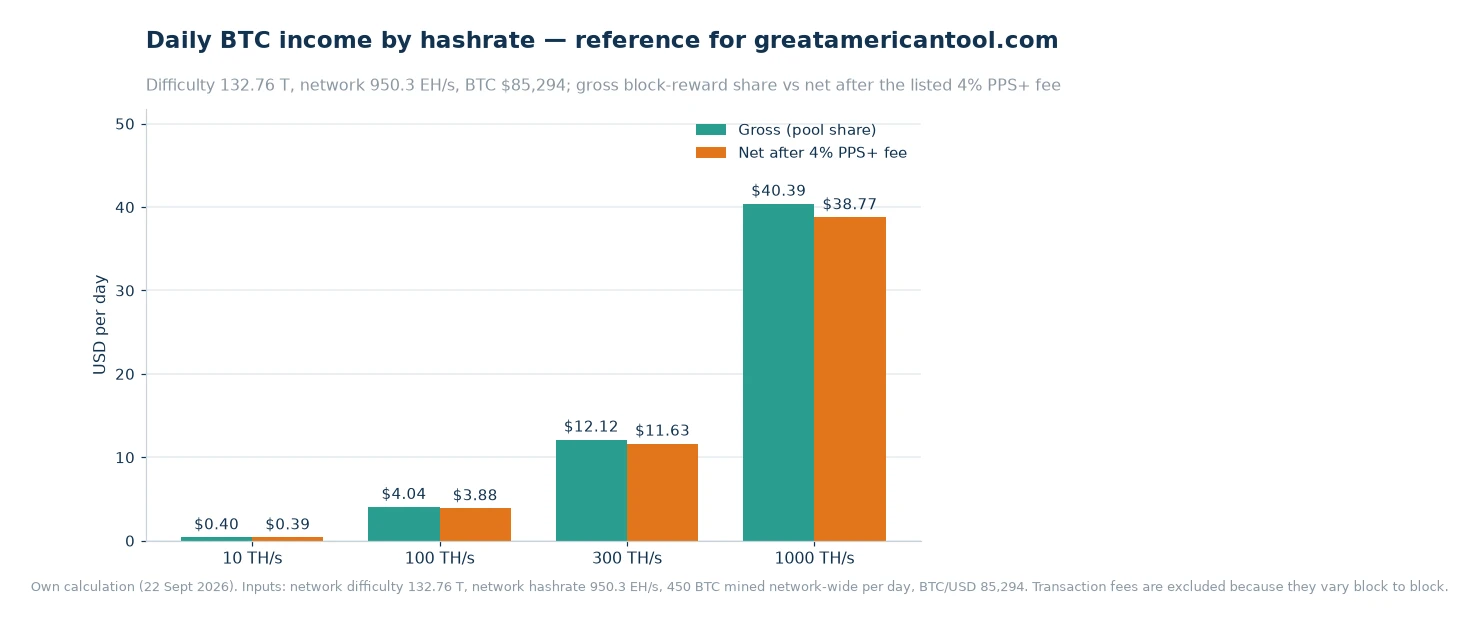
The same arithmetic scales across a fleet without changing shape. Ten TH/s grosses $0.40 a day and nets $0.39. One hundred TH/s grosses $4.04 and nets $3.88. Three hundred TH/s grosses $12.12 and nets $11.63. One thousand TH/s grosses $40.39 and nets $38.77. Nothing in that ladder depends on the vendor's brand; only the capital price and the joules per terahash differ.
Efficiency decides which machines survive
Joules per terahash is the specification that decides whether a machine can operate in your building at all. At 20 J/TH a unit draws 0.48 kWh per TH/s per day, which puts the power breakeven at $0.0841 per kWh gross and $0.0808 per kWh after the listed 4% is applied to the block-reward component. At 15 J/TH the same calculation moves to 0.36 kWh per TH/s per day and a breakeven of $0.1122 gross, $0.1077 net.
That gap changes purchasing decisions. A cheaper machine with worse efficiency can cost more over its life than a dearer efficient one, and the crossover point is exactly your electricity price: below $0.0808 per kWh even a 20 J/TH unit keeps a margin, and above $0.1077 per kWh nothing in this bracket covers power from the block-reward share alone.
Two further specifications deserve a line in the model. Delivered hashrate is the number the pool sees and pays on, not the number on the box, so a machine that throttles in a warm room has a lower effective hashrate than its rating. And firmware behaviour under load determines whether restarts are clean or whether a unit spends an hour reconnecting at the rate that costs you.
| Efficiency | Energy per TH/s per day | Breakeven power price, gross | Breakeven power price, after the listed fee |
|---|---|---|---|
| 20 J/TH | 0.48 kWh | $0.0841 per kWh | $0.0808 per kWh |
| 15 J/TH | 0.36 kWh | $0.1122 per kWh | $0.1077 per kWh |
| What efficiency does not change | Revenue per TH/s, fixed by network difficulty | $0.0404 per TH/s per day | $0.0388 per TH/s per day |
Worked example: 1,000 TH/s on a six-month clock
Take a 1,000 TH/s unit. Daily gross income is $40.39 and the listed 4% on the block-reward component takes $1.62, so $38.77 a day reaches the account. Over 30 days that is $1,163.14, and over six months — assuming difficulty and price hold — $6,978.82.
Now apply the payback division to a purchase price. If you paid $10 per TH/s, the capital was $10,000 and the daily net income of $38.77 returns it in about 258 days. At $20 per TH/s the capital doubles to $20,000 and the payback stretches to roughly 515 days. At $30 per TH/s it is $30,000 and about 773 days. Every one of those windows has to be adjusted for power and hosting before it is a real number.
Add the downtime line and the windows lengthen again. At 1 PH/s an hour offline costs $1.68 of gross income, which at 1,000 TH/s reads as $38.77 a day of net income lost. A unit that is down for four days across a year pushes the 258-day payback past 270 days, and the same four days on the $30-per-TH/s machine pushes it past 800. Downtime is not a rounding error in a payback model.
Where the hashrate actually goes
Hardware is only half of an operating plan. Once a machine is bought, ViaBTC Bitcoin Mining collects the delivered hashrate and settles it against current difficulty, so the number that matters at the pool is the one your machines actually report, not the one you paid for. Comparing the two after the first week is the fastest audit a new fleet can run.
Before buying, check the fee leg against the listed fee schedule so the net figure in your payback sum is the one that will be paid, and read the Mining Companies directory if part of the fleet will sit in someone else's building. Hosting changes the cost side of the division without changing the revenue side at all, and it belongs in the model before the order is placed rather than after.
Frequently asked questions
How do I compare two machines before buying?
Work out net income per TH/s — $0.0388 a day at current difficulty and price — then divide the purchase price per TH/s by it. That gives payback days before power and hosting, which is the honest starting point.
Does a more efficient machine always pay back faster?
Only if your electricity price sits on the right side of the breakeven. At 20 J/TH the net breakeven is $0.0808 per kWh and at 15 J/TH it is $0.1077, so a cheaper inefficient unit can lose to a better machine at the same price.
What does downtime do to payback?
It stretches it by a known amount. At 1,000 TH/s each lost day removes $38.77 of net income, so four days off across a year adds more than a week to a 258-day payback.
Choose on the division, then watch the delivered number
Run the sum before every purchase: net income per TH/s, capital per TH/s, and the payback window that falls out of them, then discount it for your power price, hosting and an honest downtime allowance. After the machines arrive, compare delivered hashrate against the pool's record in the first week, because a fleet that underperforms its rating is paying the same capital for fewer coins. Re-run the division when difficulty steps — the next adjustment is estimated at 1.90% — and retire units whose efficiency no longer clears the power breakeven instead of adding more of them.
Data and sources: Bitcoin network readings of 22 Sept 2026 — difficulty 132.76 T, next adjustment estimated +1.90%, 3.125 BTC per block with 450 BTC issued daily, BTC at $85,294 — together with the ViaBTC listed fee schedule and the Miner Profitability Ranking[1], read 22 Sept 2026. Figures are arithmetic on those inputs and are not a promise of earnings.